Symmetry and Rigid Transformations in The Lontara Script: An Ethnomathematical Analysis of The Bugis–Makassar Ina' Sure' and Its Didactic Translation Into Coordinate Geometry
Keywords:
Ethnomathematics, Lontara Script, Symmetry, Geometric Transformations, Coordinate GeometryAbstract
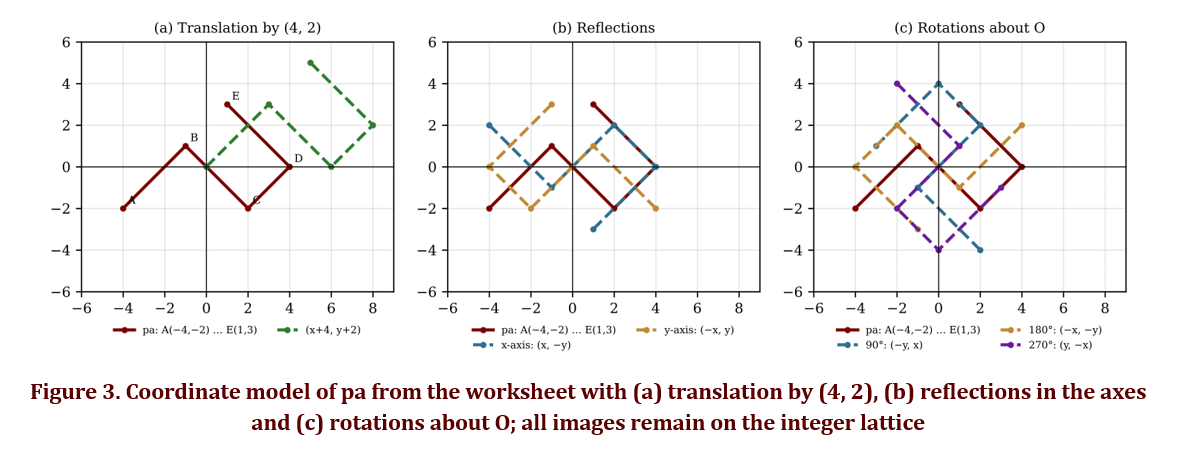
Ethnomathematical studies of Indonesian scripts have so far listed isolated geometric features, such as parallel lines or a rhombus, without analysing a script as a coherent geometric system or linking it to the formal treatment of transformations in school mathematics. This study examines the Bugis–Makassar Lontara script to (1) characterise the stroke geometry and symmetry of its 23 basic characters (ina' sure'), (2) identify the transformation relations that connect characters, and (3) translate these findings into coordinate-geometry tasks for lower-secondary students. A qualitative ethnomathematical design was used, combining document analysis of cultural and philological sources with a reproducible computational analysis of the standardised Unicode glyphs and a didactical-phenomenological analysis of an existing student worksheet. Diagonal strokes accounted for a mean of 91.4% of contour orientation (range 83.9–98.7%). Twelve characters had at least one isometric self-symmetry: sa and ha have two perpendicular mirror axes and a half-turn (D2), nine characters have a single vertical mirror axis (D1), and ka has only a half-turn (C2), produced by translating one stroke. Between characters, ma and da are exact half-turn images of ta and na, while ga, nra, mpa, ya and a are built by adding marks to a shared base. Because nearly all strokes have slope ±1, characters can be placed on the integer lattice so that translations, reflections and quarter-turns map lattice points to lattice points. The script therefore offers a culturally grounded and mathematically exact context for teaching the coordinate rules of transformations.
Downloads
Published
Issue
Section
License
Copyright (c) 2026 Ethnomathica: Journal of Ethnomathematics Studies

This work is licensed under a Creative Commons Attribution-ShareAlike 4.0 International License.