Ethnomathematical Exploration of Functions, Logarithms, and Transcendental Equations in The Kecapi and Calong Traditional Musical Instruments of Mandar, West Sulawesi
Keywords:
Ethnomathematics, Ethnomodelling, GeoGebra, Mathematical Modelling, Mandar Musical InstrumentsAbstract
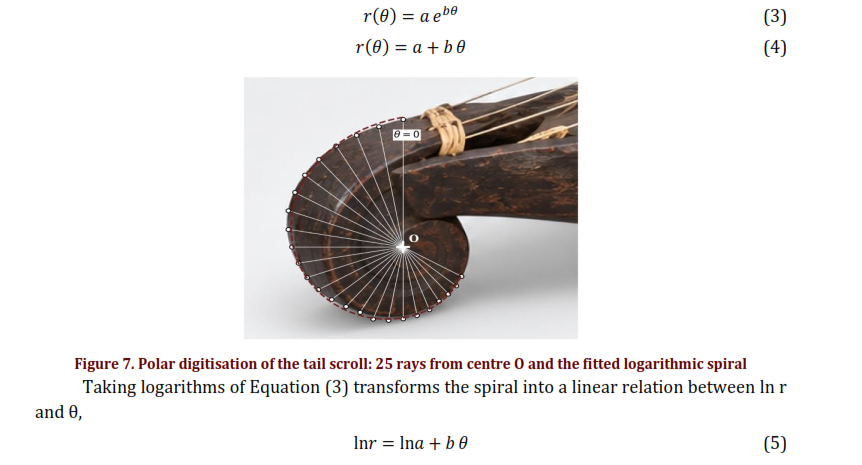
Ethnomathematics research on Indonesian cultural artefacts has been dominated by the identification of plane and solid figures, leaving the functional, analytic, and acoustic mathematics embedded in artefacts largely unexplored. This study explores the mathematical ideas embodied in two traditional musical instruments of the Mandar people of West Sulawesi, the boat-shaped two-stringed kecapi and the coconut-resonated calong, deliberately excluding plane and solid geometry. A qualitative exploratory ethnomathematics design framed by ethnomodelling (emic, etic, and dialogic perspectives) was combined with digital mathematical modelling. Three photographs of the instruments were digitised, and the resulting data were modelled with least-squares regression, polar-coordinate analysis, logarithmic transformation, and numerical root finding, with every model made reproducible in GeoGebra. Five mathematical ideas emerged. The kecapi keel is described by a quadratic function (R² = 0.999) that is practically indistinguishable from a catenary, with maximum curvature at about one quarter of the body length. The carved tail scroll follows a logarithmic spiral (R² = 0.991) better than an Archimedean spiral. The five finger-posts are equally spaced (coefficient of variation 5.3%), forming an arithmetic sequence whose musical intervals follow a reciprocal-logarithmic function. The vibration of each calong key is governed by the transcendental equation cos x cosh x = 1, whose roots locate the ideal support points at 0.224 and 0.776 of the key length, and its pitch follows an inverse-square power function of key length. The findings extend ethnomathematics beyond shapes toward functions, sequences, logarithms, and hyperbolic functions, and offer culturally grounded, technology-supported contexts for secondary and tertiary mathematics and physics education.
Downloads
Published
Issue
Section
License
Copyright (c) 2026 Andini, Nur Lela, Muh. Rafly Al Farezy Arif (Author)

This work is licensed under a Creative Commons Attribution-ShareAlike 4.0 International License.