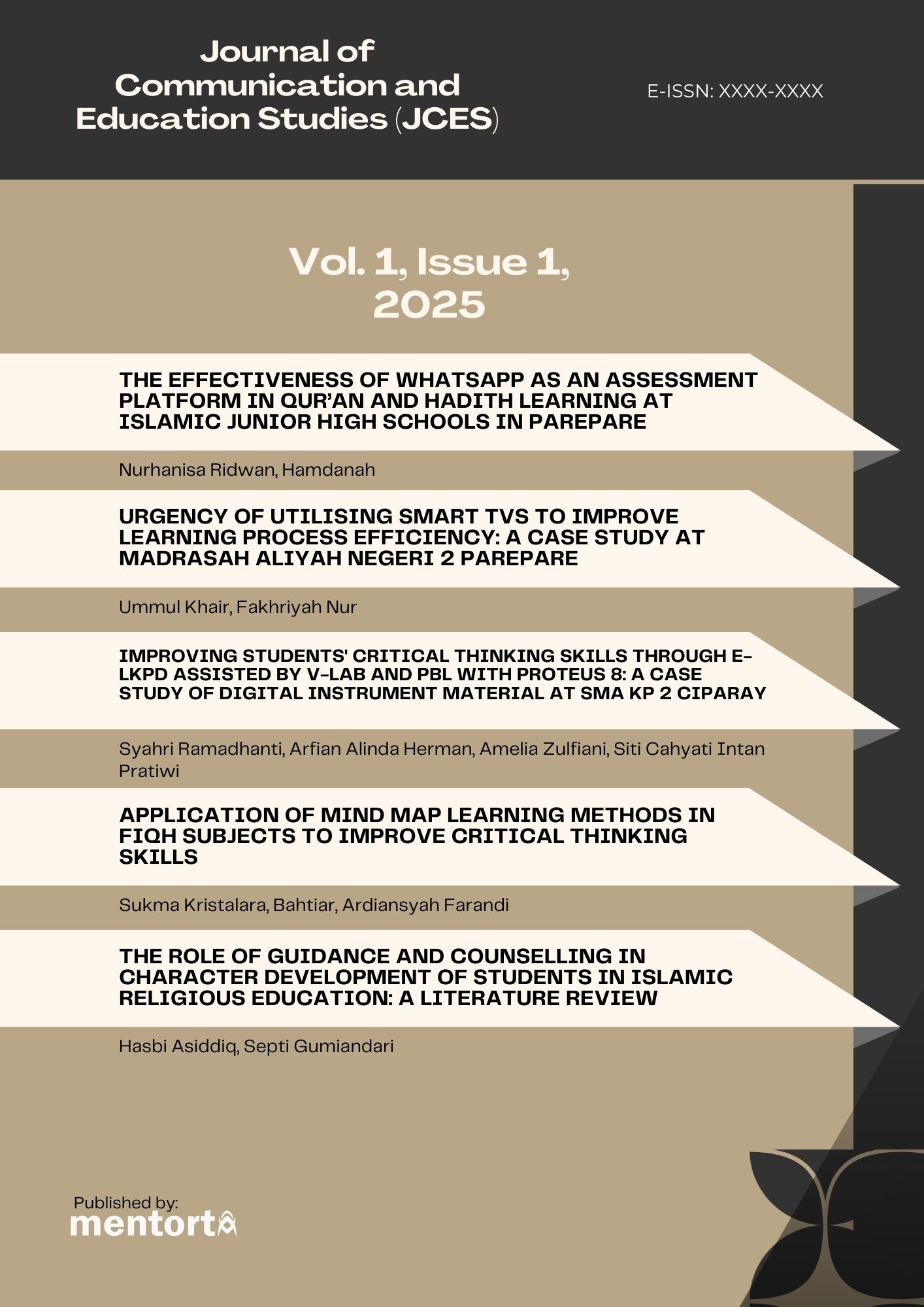
Urgency of Utilising Smart TVs to Improve Learning Process Efficiency: A Case Study at Madrasah Aliyah Negeri 2 Parepare
Kata Kunci:
Smart TV, Learning Efficiency, Educational Technology, State MadrasahAbstrak
Education in the digital age faces challenges in terms of learning process efficiency, especially in state madrasahs such as MAN 2 Parepare, where conventional methods are often less interactive and time-consuming. This study is based on the gap between the potential of multimedia technology, such as Smart TV, and its suboptimal utilisation, which causes inequality of access between classes and a decline in student motivation. The main objectives of this study are to describe the forms of Smart TV utilisation, analyse its urgency in improving efficiency, and identify barriers and solutions to its implementation at MAN 2 Parepare. The research method used a descriptive qualitative approach with data collection through participant observation, semi-structured interviews with teachers and students, and documentation studies, analysed using NVivo 12 Pro based on the Miles & Huberman interactive model for data reduction, presentation, and verification. The results showed that teachers utilised Smart TVs partially, mainly through educational videos, educational applications, and YouTube access, which increased time efficiency by 20-30%, student motivation by up to 50% active participation, and visual material comprehension, despite obstacles such as internet disruptions and uneven facilities. The conclusion states that Smart TVs are essential as catalysts for educational transformation, with practical implications in the form of recommendations for infrastructure improvements and teacher training to support the Merdeka Curriculum. The contribution of this research to the fields of education and communication is to provide empirical evidence of technology integration in Islamic-based madrasas, enrich the literature on digital learning efficiency, and offer a model of technology equity that can be applied in similar institutions to improve the quality of inclusive education in Indonesia.
Unduhan
Unduhan
Diterbitkan
Terbitan
Bagian
Lisensi
Hak Cipta (c) 2025 Ummul Khair, Fakhriyah Nur (Author)

Artikel ini berlisensiCreative Commons Attribution-ShareAlike 4.0 International License.