Main Menu
Terbitan Terkini
Vol 1 No 2 (2026): Journal of Communication and Education Studies (JCES)
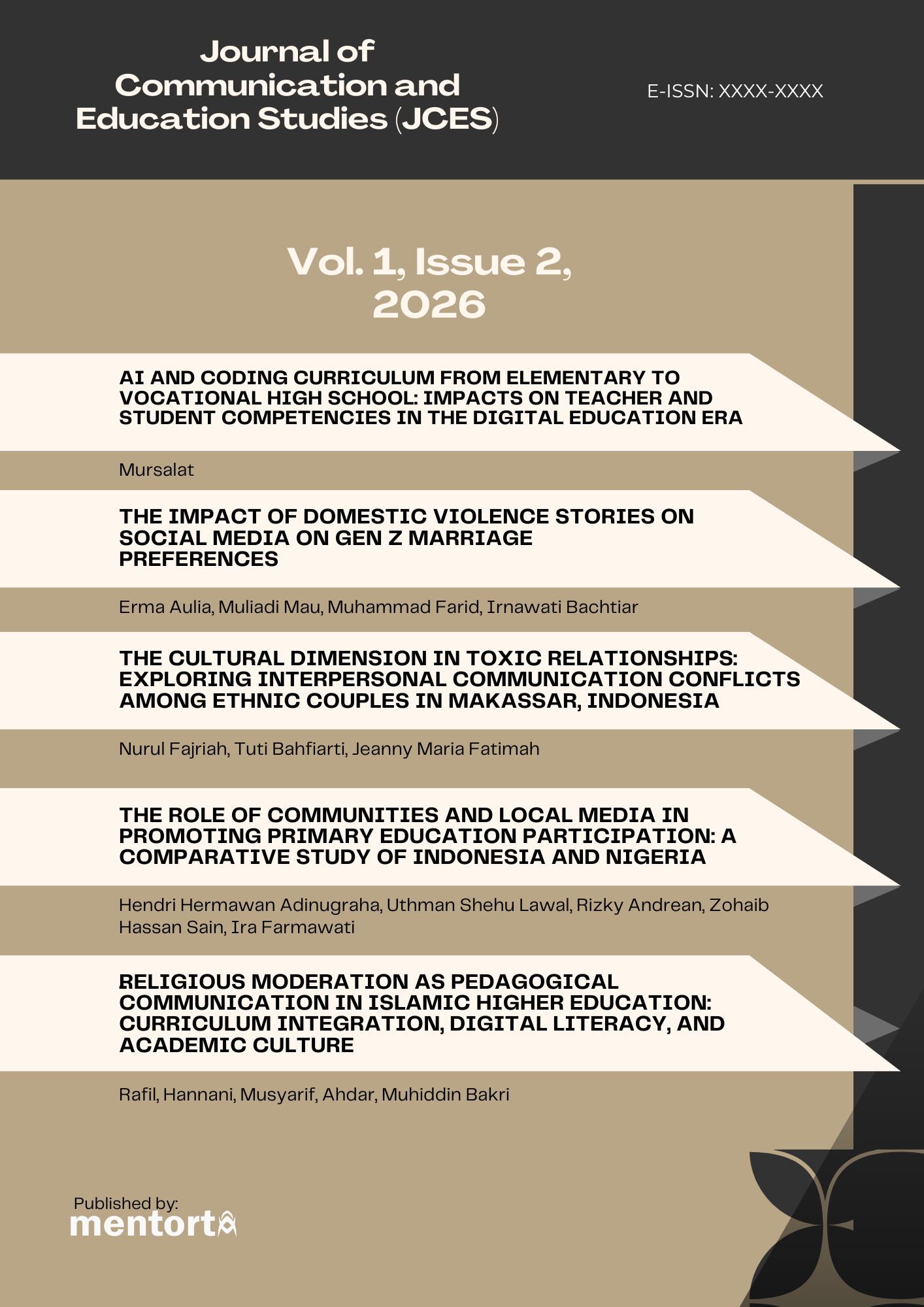
This issue includes 5 original research articles authored/co-authored by 18 authors from 5 countries:
 Indonesia
 United Kingdom
 Nigeria
 Malaysia
 Pakistan
Diterbitkan:
2026-04-30
Articles
-
AI and Coding Curriculum from Elementary to Vocational High School: Impacts on Teacher and Student Competencies in the Digital Education Era
Abstrak View: 75 PDF (Inggris) Download: 369 -
The Impact of Domestic Violence Stories on Social Media on Gen Z Marriage Preferences
Abstrak View: 152 PDF (Inggris) Download: 111 -
The Cultural Dimension in Toxic Relationships: Exploring Interpersonal Communication Conflicts Among Ethnic Couples in Makassar, Indonesia
Abstrak View: 113 PDF (Inggris) Download: 285 -
The Role of Communities and Local Media in Promoting Primary Education Participation: A Comparative Study of Indonesia and Nigeria
Abstrak View: 104 PDF (Inggris) Download: 122 -
Religious Moderation as Pedagogical Communication in Islamic Higher Education: Curriculum Integration, Digital Literacy, and Academic Culture
Abstrak View: 96 PDF (Inggris) Download: 201
Journal of Communication and Education Studies
Editor-in-Chief: Muh. Ilham Jaya| Publisher: Mentorta

Journal Information
- Original Title: Journal of Communication and Education Studies (JCES)
- E-ISSN: 3163-2769
- Frequency: 3 issues per year (December, April, and August)
Synopsis
Journal of Communication and Education Studies (JCES) is an international peer-reviewed journal dedicated to advancing interdisciplinary scholarship at the intersection of communication and education. JCES conceptualises Communication and Education Studies as a field of inquiry that examines how communication shapes learning processes, knowledge construction, literacy development, and educational transformation across diverse educational contexts.
JCES particularly encourages research that investigates how communication practices, media, digital technologies, and evolving communication environments influence learning experiences in formal, non-formal, informal, and lifelong learning settings. The journal is especially interested in studies addressing contemporary educational challenges arising from digital transformation, artificial intelligence, media convergence, changing communication practices, and the evolving relationship between technology, knowledge, and society.
JCES prioritises theoretically informed and empirically grounded research that advances the understanding of communication as a social, cultural, technological, and pedagogical process. Education is not regarded merely as the context of research, nor is communication treated simply as an auxiliary variable. Rather, every article is expected to make a substantive scholarly contribution to understanding how communication shapes educational processes, experiences, and outcomes.